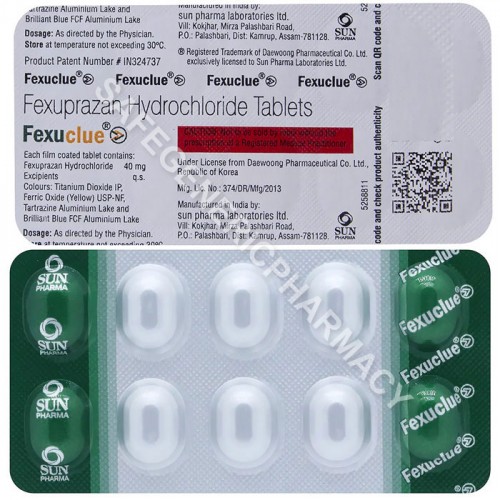
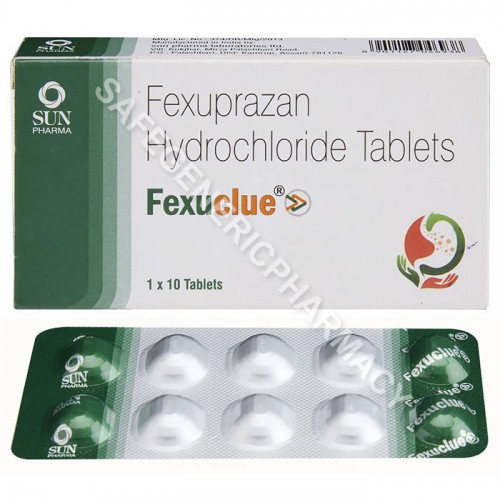
Fexuclue 40mg Tablet (Fexuprazan)
Medicine OverView
Fexuclue contains fexuprazan 40 mg, a potassium-competitive acid blocker prescribed for adults with erosive esophagitis. This guide explains its approved use, action, administration, safety precautions and other essential medicine information.
| Brand name | Fexuclue Tablet 40 mg |
|---|---|
| Active ingredient | Fexuprazan hydrochloride equivalent to fexuprazan 40 mg |
| Medicine class | Potassium-competitive acid blocker (P-CAB) |
| Approved use in India | Treatment of erosive esophagitis in adults |
| Manufacturer | Sun Pharmaceutical Industries Ltd. |
| Route | Oral |
| Food instructions | May be taken with or without food, according to the available prescribing information |
| Prescription status | Use only under the supervision of a qualified healthcare professional |
Sun Pharma introduced Fexuclue 40 mg in India in April 2025 after fexuprazan hydrochloride tablets 40 mg were approved by India’s Central Drugs Standard Control Organisation for erosive esophagitis. Sun Pharma obtained the Indian rights to manufacture and commercialise the medicine from Daewoong Pharmaceutical, the company that developed fexuprazan.
Fexuclue Tablet 40 mg is an acid-suppressing prescription medicine containing fexuprazan. It belongs to a newer group of medicines known as potassium-competitive acid blockers, usually abbreviated as P-CABs. Doctors may prescribe it to adults with erosive esophagitis, a form of gastroesophageal reflux disease in which repeated exposure to stomach contents inflames and damages the lining of the esophagus.
When acidic stomach contents repeatedly flow back into the esophagus, they can cause heartburn, sour-tasting regurgitation and irritation. Erosive esophagitis involves visible breaks in the esophageal lining, usually assessed during an endoscopy. By reducing gastric acid, Fexuclue creates a more favorable environment for this lining to heal and may ease acid-related symptoms.
Fexuclue is not an antacid. Antacids neutralize some acid already in the stomach for a limited period. Fexuprazan acts at the acid-producing proton pump and is intended to provide sustained acid control when taken as prescribed.
Fexuclue 40 mg is approved in India for the treatment of erosive esophagitis in adults. Erosive esophagitis is commonly caused by gastroesophageal reflux, but a clinician may need to confirm the diagnosis and assess its severity before prescribing treatment. Symptoms can include heartburn, acid regurgitation, discomfort behind the breastbone, painful swallowing or difficulty swallowing. Some people have limited symptoms despite visible esophageal injury, while similar symptoms can also arise from other conditions.
The medicine’s goals are to suppress gastric acid, support healing of erosions and help control acid-related symptoms during the prescribed treatment period. In Sun Pharma’s announced Phase 3 study in Indian adults, healing was confirmed by endoscopy and more than 95% of patients achieved healing by eight weeks. A separate randomized Phase 3 study conducted in Korea found fexuprazan 40 mg non-inferior to esomeprazole 40 mg for cumulative healing at eight weeks. Individual results still vary, and clinical trial outcomes cannot predict a particular patient’s response.
Do not assume that recurring chest pain, indigestion, nausea or swallowing difficulty is simply acid reflux. Heart disease, ulcers, infections, medication-related injury and other disorders can produce overlapping symptoms. Fexuclue may reduce acid-related discomfort and could mask warning signs, so professional evaluation is important, especially when symptoms are new, severe, persistent or unusual.
Specialized parietal cells in the stomach produce hydrochloric acid. A key final step in this process is controlled by the gastric hydrogen-potassium adenosine triphosphatase enzyme, commonly written as H+/K+-ATPase and often called the proton pump. Potassium ions participate in the pump’s operation.
Fexuprazan binds competitively and reversibly at the potassium-binding area of this proton pump. By interfering with potassium-dependent pump activity, it reduces the release of hydrogen ions into the stomach and therefore suppresses gastric acid secretion. Unlike conventional proton pump inhibitors, fexuprazan can inhibit the pump directly without first requiring acid activation.
Sun Pharma describes a fast onset, stable acid suppression and an approximately nine-hour half-life. Food did not meaningfully change exposure or acid-control measurements in the cited product information, supporting administration with or without food. Healing still takes time, so continue the prescribed course unless your doctor tells you to stop or a serious reaction occurs.
When prescribed for a suitable adult patient with erosive esophagitis, Fexuclue offers several practical and therapeutic features:
These features are not a guarantee of cure. A doctor should decide whether Fexuclue is suitable after considering the diagnosis, other medicines, pregnancy status and overall health.
Take Fexuclue exactly as directed by your doctor and follow the instructions printed on your supplied pack. The available prescribing information for adults with erosive esophagitis describes 40 mg taken orally once daily for four weeks. If the esophagitis has not healed or symptoms persist, a doctor may continue treatment for a further four weeks. Do not extend the course yourself.
Follow the patient leaflet or your prescriber’s instructions. In general, take a missed dose when you remember unless it is nearly time for the next scheduled dose. If the next dose is close, skip the missed dose and return to the usual schedule. Never take two doses together to compensate without medical advice.
Contact a doctor, pharmacist, poison information service or emergency department promptly, even if you currently feel well. Bring the medicine strip or package so healthcare staff can identify the product and amount. The available information reports no specific antidote; management is based on monitoring and supportive care as clinically required.
Like all medicines, Fexuclue can cause side effects, although not everyone experiences them. Events reported in clinical trials of fexuprazan 40 mg included indigestion, diarrhea, nausea, abdominal discomfort, headache, skin redness and back pain. Less frequently reported events included dizziness, altered taste, itching, facial swelling, muscle pain, chest discomfort and runny nose. An event observed during a trial is not always proven to have been caused by the medicine.
Many gastrointestinal effects are mild, but persistent or severe symptoms deserve medical advice. Watery or prolonged diarrhea, especially with fever, abdominal pain, dehydration or blood, should be assessed promptly because strong acid suppression may slightly increase susceptibility to certain gastrointestinal infections.
This list is not exhaustive. Read the leaflet supplied with the medicine and tell your doctor about any new or troubling symptom. Do not drive or operate machinery if you feel dizzy or otherwise impaired.
Tell your doctor about all current illnesses, allergies, test results and medicines before starting Fexuclue. Extra caution or a different treatment plan may be needed in some situations.
Acid suppression can improve symptoms even when a more serious disorder is present, potentially delaying diagnosis. Seek medical evaluation if you have unintended weight loss, recurrent vomiting, difficulty or pain when swallowing, vomiting blood, black stools, anemia, a new stomach ulcer or symptoms that continue despite treatment. A clinician may need to exclude malignancy or another cause before or during therapy.
Safety and efficacy have not been established in patients with hepatic or renal impairment in the cited prescribing information. Tell your doctor if you have liver or kidney disease. Older adults may be more likely to have reduced organ function or multiple interacting medicines and should use Fexuclue carefully under professional supervision.
Any longer-term use should be medically reviewed. Prolonged acid-suppressing therapy has been associated with concerns such as low magnesium and osteoporosis-related fractures. Patients using digoxin, diuretics or medicines that lower magnesium may require monitoring.
Do not take Fexuclue if you are allergic to fexuprazan or any ingredient in the supplied tablet. Some Fexuclue formulations contain lactose and Yellow No. 4 (tartrazine). The referenced product information contraindicates use in people with certain rare hereditary conditions involving galactose intolerance, Lapp lactase deficiency or glucose-galactose malabsorption and advises caution with tartrazine allergy. Check your local pack because excipients can differ.
Safety and effectiveness have not been established in children or adolescents. Do not give this medicine to a child unless a qualified specialist specifically directs it.
Give your doctor and pharmacist a complete list of prescription drugs, over-the-counter medicines, vitamins, herbal products and supplements. Do not start, stop or change a medicine because of information on this page.
By raising gastric pH, fexuprazan can change the absorption of oral medicines whose bioavailability depends on an acidic stomach. The referenced prescribing information lists medicines containing atazanavir, nelfinavir or rilpivirine as contraindicated because reduced absorption may compromise antiviral treatment. Other pH-dependent medicines may also require assessment.
Fexuprazan is metabolized mainly by the CYP3A4 enzyme, with lesser involvement from CYP2B6, CYP2C19 and CYP2D6. In a studied regimen, co-administration with clarithromycin produced only a small change in fexuprazan exposure that was not considered clinically significant. This finding should not be generalized to every CYP3A4 inhibitor, inducer or combination. Your prescriber should review possible interactions individually.
Tell your clinician if you use digoxin, diuretics or another medicine associated with low magnesium, especially if prolonged acid suppression is planned. Also mention antifungals, cancer medicines, immunosuppressants and other therapies that may depend on gastric pH or have a narrow therapeutic range. A pharmacist can check the most current interaction database for your exact medicines and doses.
The referenced Fexuclue prescribing information contraindicates use during pregnancy because adequate clinical trial data in pregnant women are unavailable. Tell your doctor immediately if you are pregnant, planning a pregnancy or think you may be pregnant. Do not use the medicine based only on internet advice.
It is not known whether fexuprazan passes into human breast milk; transfer into milk has been reported in animal studies. The referenced product information advises discontinuing breastfeeding if treatment is used. A healthcare professional should help weigh the importance of treatment against the benefits of breastfeeding and discuss suitable alternatives.
No simple interaction statement makes alcohol automatically safe. Alcohol can trigger or worsen reflux, irritate the upper gastrointestinal tract and interfere with healing habits. Ask your doctor whether you should avoid it during treatment; limiting or avoiding alcohol is often sensible when reflux symptoms are active.
Dizziness has been reported. Until you know how Fexuclue affects you, use caution with driving, riding, machinery or work requiring full alertness. Do not perform these activities if you feel dizzy, faint or visually impaired.
Medicine works best as part of a plan tailored to the causes and pattern of your reflux. The following measures may help some people, but not every trigger affects everyone:
Lifestyle changes do not replace prescribed treatment for documented erosive injury. Arrange follow-up if symptoms persist, return quickly after the course, or include difficulty swallowing, bleeding or weight loss.
Buy prescription medicines only through a lawful, reputable pharmacy that requires the documentation applicable in your country. Check the product name, strength, manufacturer, batch number, expiry date and seal when it arrives. Contact the dispensing pharmacy before use if anything appears incorrect.
It is approved in India to treat erosive esophagitis in adults. This is acid-related inflammation and visible damage to the lining of the esophagus. A doctor should confirm that the medicine is appropriate for your symptoms and diagnosis.
Neither. Fexuclue is a potassium-competitive acid blocker. It suppresses acid at the gastric proton pump through reversible, potassium-competitive binding. It shares a treatment goal with proton pump inhibitors but uses a different binding mechanism.
Yes. The available prescribing information states that fexuprazan 40 mg may be taken with or without food. Follow your doctor’s timing instructions and try to take it consistently.
Fexuprazan begins suppressing acid after administration, but symptom improvement and healing time vary. The labeled treatment course is generally four weeks, with a further four weeks considered by a doctor when healing is incomplete or symptoms persist. Do not stop early or extend treatment yourself.
The referenced product information contraindicates it during pregnancy because adequate human clinical data are not available. Inform your prescriber if you are pregnant, may be pregnant or plan to conceive.
Clinical trials reported effects including indigestion, diarrhea, nausea, abdominal discomfort, headache, skin redness and back pain. Seek advice for persistent effects and urgent help for facial or throat swelling, breathing difficulty, severe rash, bleeding or other serious symptoms.
Some combinations are unsafe. Atazanavir, nelfinavir and rilpivirine are specifically contraindicated in the referenced information because acid suppression may reduce their absorption. Ask a doctor or pharmacist to review every medicine and supplement you use.
Content review date: 1 August 2026. If the supplied carton or leaflet differs from this page, follow the official local product information and consult the dispensing pharmacist.
What do you think about this product?